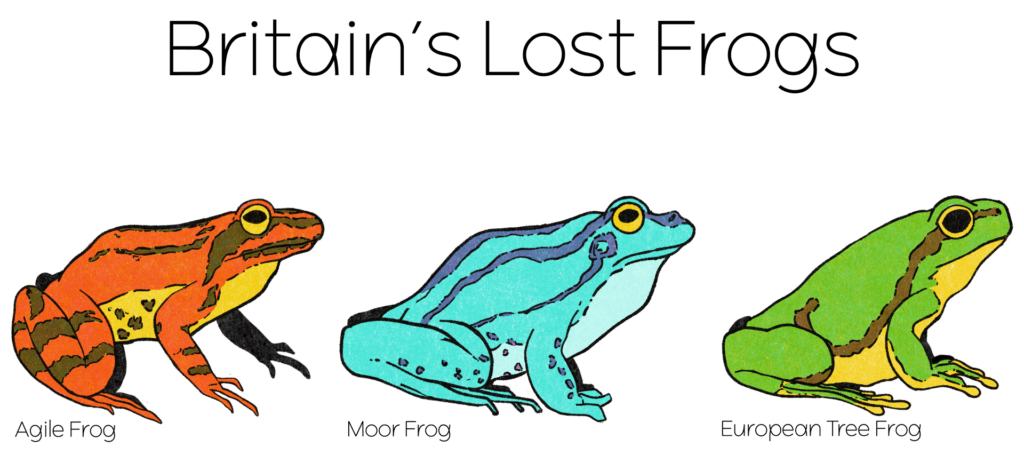
This is one of our UK species reintroduction projects focused on three pre-industrial species of frogs. Learn more about these species, and the project below.
The Agile Frog
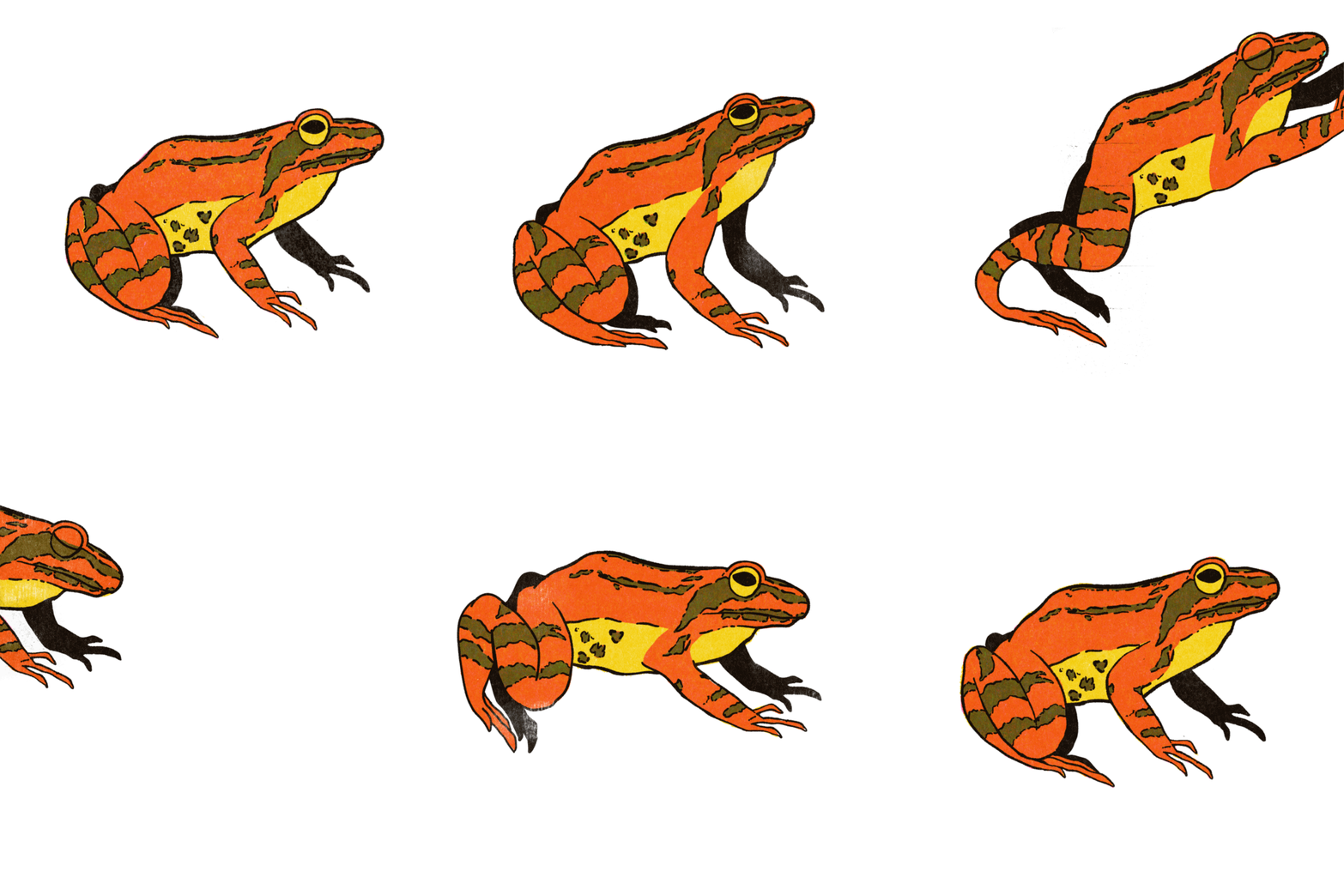
The agile frog is a woodland species, becoming specifically tied to open, oak-hazel woodland in the northern edge of its range in Sweden. It needs fairly nutrient poor, semi-permanent and fish free ponds to deposit its eggs. It breeds the earliest of the brown frogs, while ice is still on the ground. This gives it a specific competitive advantage over the other two species.
The Moor Frog
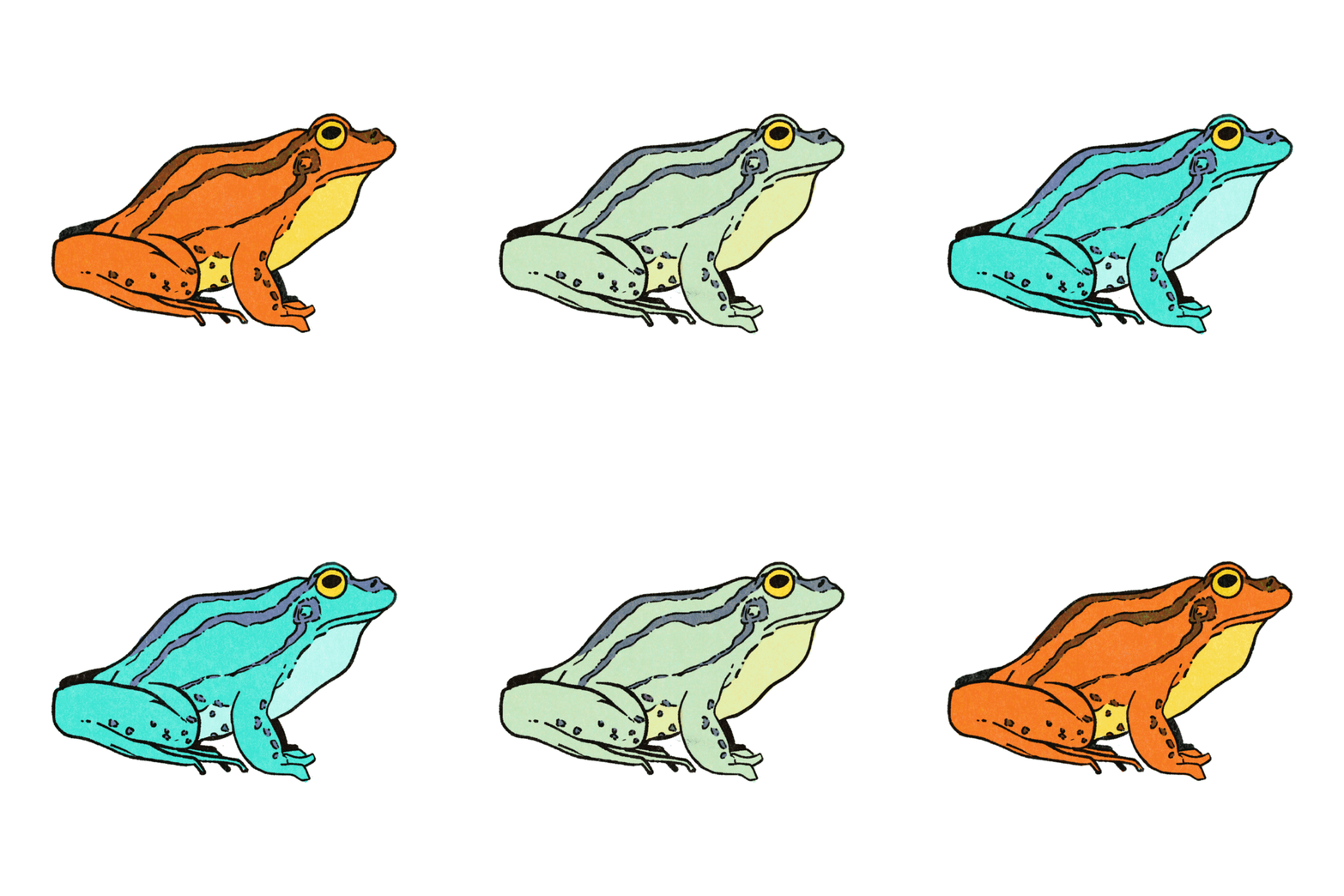
The moor frog is strongly associated with peaty habitats in north-western Europe, such as raised bogs, large mires and oligotrophic fens. It is often found in open habitats dominated by heather and purple moor grass, with a humid and dense microclimate. Breeding takes place in fish-free, shallow, extensive wetlands, where the males often turn a lavender blue for a few days. The frog has been found to be facilitated by the Eurasian beaver in certain areas.
The European tree Frog
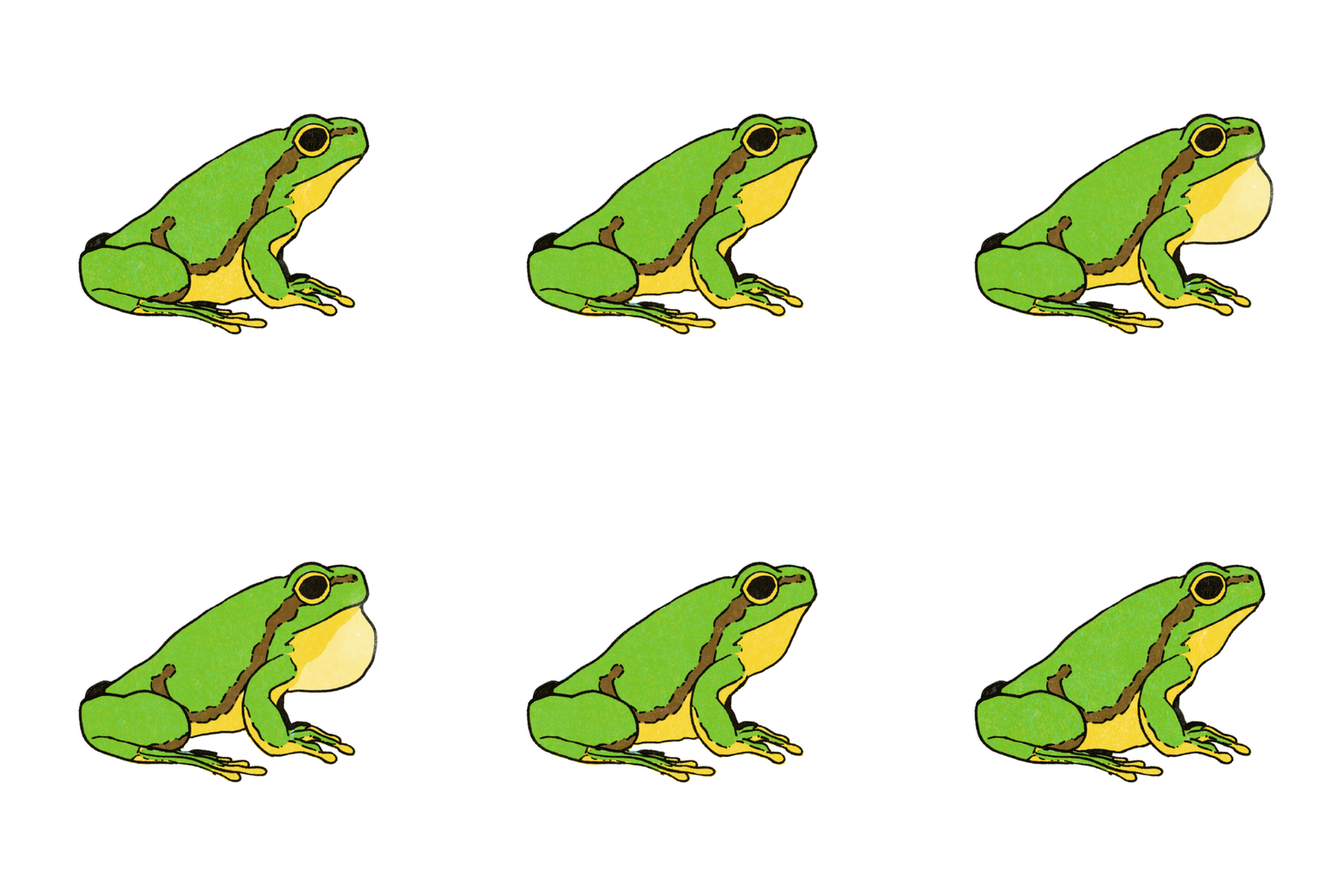
The tree frog is a specialist of warm, lowland landscapes with abundant ponds and scrubby vegetation. It is found in open and often surprisingly dry habitats in northern Europe, such as bramble scrub and even dunes. Eggs are laid in shallow, fish-free ponds with fairly dense emergent plants. Breeding begins later than Britain’s brown frogs and continues into early summer. In the day individuals are often basking among vegetation. At night males gather in choruses, producing a loud, distinctive call that carries across the landscape for over a mile.
You can find out more information on the project, and how to support it by following our socials, and the links below.
The European pond turtle (Emys orbicularis) was once present in Britain’s freshwater systems some 3000-4000 years ago before its multifaceted demise.
The European pond turtle is Britain’s only native species of freshwater chelonian, being found across mainland Europe. It is an omnivore though predominantly takes insects and carrion (dead animals). It occassionally eats vegetation. Their gold speckling helps them blend in with floating pond weeds. They spend most of their time basking out of the water but do all of their feeding in the water.
The Evidence
A past and potential future range of European pond turtles in northern Europe. Dashed line; probable early-Holocene northernmost range-edge (Sommer et al., 2007 & 2009; Stuart, 1979), green shading; approx. current range, blue triangles; modern day successful hatching events and reintroductions, red diamonds; potential reintroduction sites.
Recent sedimentary ancient DNA (sedaDNA) analysis has found that pond turtles were present on Doggerland (the prehistoric land bridge connecting Great Britain to mainland Europe) right up until its end of the last glacial period . This confirms the nativeness of the sub-fossils . This places European pond turtles firmly within standard definitions for what is considered a native species in a British context. Lemoine & Svenning’s recent review of the nativeness concept used European pond turtles to define the term ‘Historic Native’, as the species had previously occupied a larger range in Europe within the last 10,000 years. Under the IUCN’s definitions, the term ‘Indigenous Range’ applies, as in the case of the pond turtle, historical evidence is hitherto unknown. Nevertheless, both definitions suggest that the species can be reintroduced to its former range.
Beaver created wetland, ideal for European Pond Turtles.
The degradation of British wetlands by drainage, canalisation, and pollution, has been a centuries-old process, resulting in a 90% reduction of this habitat . Human impacts from as far back as the Neolithic, such as hunting, land clearance and the burning of reedy and peat wetland, have resulted in the loss of key ecosystem functioning, or trophic downgrading. It is known that several ‘iconic’ wetland species perished during similar time as the European pond turtle. This includes white stork, black stork , dalmatian pelican , night heron, pygmy cormorant , common crane, elk, and aurochs.
Research has revealed that turtles are vital components of healthy ecosystems. Freshwater turtles exist at astonishingly high densities, often eclipsing densities of many other groups (such as mammals, birds, and other reptiles). This suggests that when turtles are removed there could be substantial ecological changes . The European pond turtle likely performs functions critical to wetland health.
Some of the potential benefits of the European Pond Turtle in Britain
Transferring of nutrients between land and water.
Distribution of wetland plant seeds due to the species omnivorous diet.
Potential 'cleaning up' of wetland habitats by removing nutrient overlads and reducing excess decomposition.
Consumers of carrion and fish kills, something that is desperately needed with the state of British rivers, and the warming climate.